Vorwort:
Traditionelle Sprachkenner wollen, dass ihr Englisch so poliert und korrekt ist wie eine bayerische Blaskapelle in Lederhosen am Sonntagmorgen. Aber amerikanisches Englisch? Nun, das ist eher wie ein Fast-Food-Drive-Thru – es geht nur um Effizienz oder, seien wir ehrlich, um Faulheit. Suchen Sie sich etwas aus.
Y’all ist eine Zusammenziehung von you und all, manchmal auch kombiniert als you-all. Laut Wikipedia ist Y’all das wichtigste Pluralpronomen der zweiten Person im südamerikanischen Englisch, mit dem es am häufigsten in Verbindung gebracht wird, obwohl es auch in einigen anderen englischen Varietäten vorkommt, darunter afroamerikanisches Englisch, südafrikanisches indisches Englisch und srilankisches Englisch.
Im Rest des Landes versteht man darunter eher den „Hillbilly Talk“. Sie lernen vielleicht amerikanischen Slang, wenn Sie wissen, dass „y’all“ Singular oder Plural, „all y’all“ Plural und „what in tarnation“ ein vollständiger Satz ist.
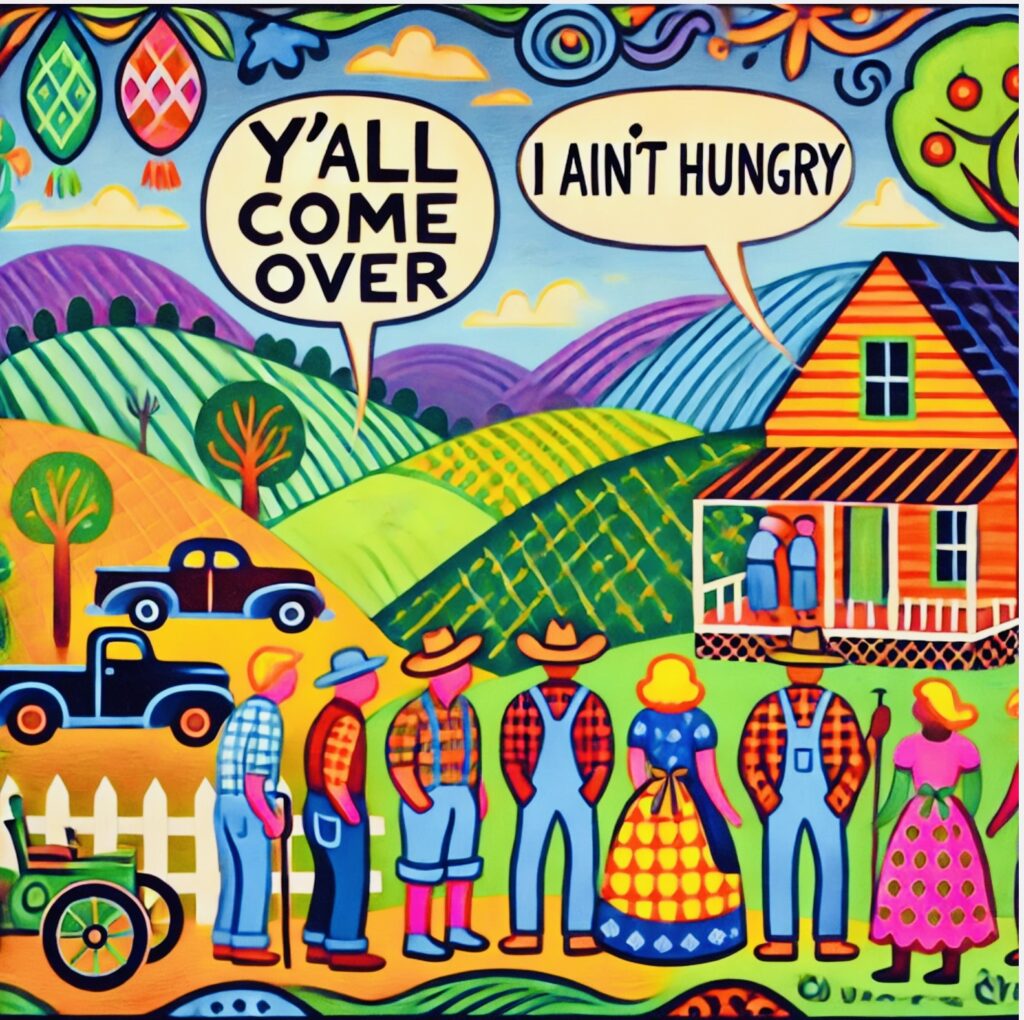
Americans slice up their words like they’re trimming a schnitzel – ‘I am going to’ becomes gonna, and ‘I want to’ gets chopped down to a breezy wanna. And why bother with ‘I will’ or ‘I am going to’ when you can squeeze it into I’m gon’ and still have enough time left over to toast a Pop-Tart?
Almost every American slips into this linguistic short-cutting, but there are common words that are avoided in formal settings because they sound too much like something out of an English professor’s nightmare. Enter ‘y’all’ and ‘ain’t.’
‘Y’all’ is like the Swiss Army knife of pronouns. It’s a Southern thing, but even the Northerners – bless their hearts – use it from time to time because it’s just easier. So when you hear ‘Y’all come over,’ it’s basically shorthand for ‘All of you, come here.’ Sure, old-school English had fancy pronouns for both the singular second person (thou or thee) and the plural second person (ye or you) and the Germans have their ‘ihr’ and ‘du,’ and ‘Sie,”but in the U.S.? Just say ‘Y’all’ and you are done!
Then there’s ‘ain’t.’ If I say ‘I ain’t hungry,’ that’s ‘I am not hungry.’ But if I say ‘Y’all ain’t got no manners,’ which, by the way, is a double negative – scandalous! – I’m technically saying ‘You all have no manners,’ but in a way that would make any grammar teacher break out in hives.
The intellectuals up North might clutch their pearls and say ‘ain’t’ isn’t ‘proper English,’ but down South, they call it creative grammar. It’s the duct tape of verbs – slap it on any sentence and boom, it holds. ‘Am not,’ ‘is not,’ ‘are not,’ ‘have not’ – it’s all covered.
Now, if someone from the deep South tells you ‘Y’all ain’t from around here, are ya?’ – relax. They’re not accusing you of trespassing. They’re just saying, ‘You’re not one of us,’ but in a way that feels like they’re offering you a sweet tea. Germans might see this as linguistic chaos, but really, it’s peak American pragmatism. Why use three words when one’ll do?
In summary: ‘Y’all’ is for bonding, and ‘ain’t’ is for bending the rules. Together, they’re the bratwurst and sauerkraut of laid-back American conversation. If you stick around the U.S., you might start tossing these words into your own sentences. But don’t overdo it – otherwise, people might think you’ve been spending too much time in the linguistic equivalent of a wild Texan rodeo.




Leave a Reply